Category: <span>Featured</span>

Featured

Joint SDG Ecosystem Day

Joint SDG Ecosystem Day is scheduled for 26 November 2025, as a full-day online event organised by European Telecommunications Standards Institute (ETSI). It brings together the communities of all ETSI Software Development Groups (SDGs) to share implementation experiences, future plans, and contributions to open-source ecosystems spanning the edge, cloud and network domains. 
 Participation is free and open, with presentations (including Q&A) invited from projects and organisations actively contributing to SDG ecosystems, underlining how ETSI sees collaboration and openness as key to shaping future technologies.

Featured

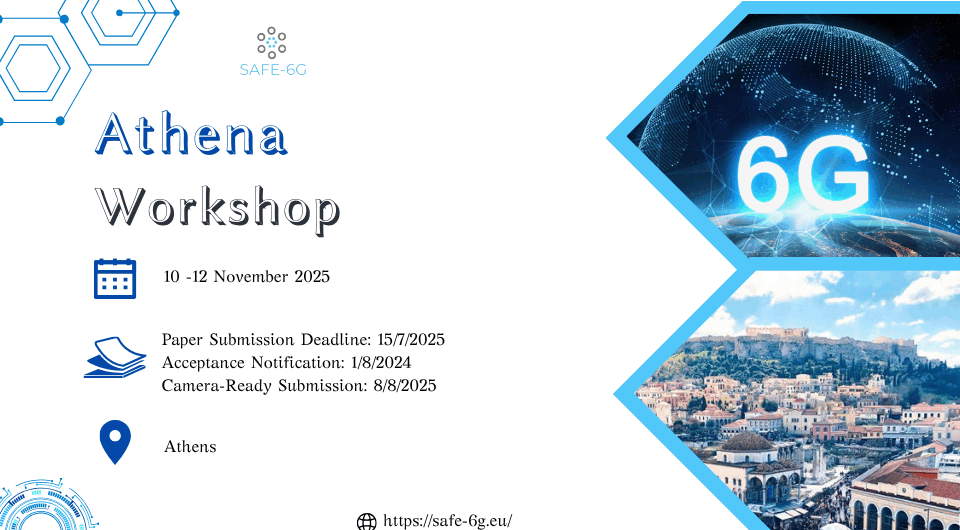
IEEE NFV-SDN 2025 – ATHENA Wordkshop

The 11th IEEE Conference on Network Functions Virtualization and Software-Defined Networking (IEEE NFV-SDN 2025) Conference will take place in the beautiful city of Athens, Greece. The conference is an important forum for the ongoing exchange of the latest ideas, developments, and results amongst ecosystem partners in both academia and industry. The conference fosters knowledge sharing and discussion on new approaches and works addressing gaps and improvements in virtualized-enabled architectures, algorithms, and operational frameworks for virtualized network functions and infrastructures.

The ATHENA 2025 workshop focuses on the pivotal advancements required for 6G networks to become a reality. The core themes revolve around research infrastructures, adaptive frameworks, and the architectural evolution of future communication systems.

The first edition of ATHENA Workshop, hosted at IEEE CAMAD 2024, was a resounding success, attracting a diverse group of researchers, industry experts, and innovators dedicated to shaping the future of 6G networks. With approximately 40 original research papers published, the workshop provided a fertile ground for discussions on advanced network infrastructures, AI-driven adaptability, and global architectural evolution. The event fostered insightful exchanges on emerging 6G technologies, cutting-edge research testbeds, and the pivotal role of adaptive frameworks in next-generation networks. ATHENA established itself as a premier venue for thought leadership in 6G research, laying a strong foundation for its continuation at IEEE SDN/NFV 2025.

The motivation behind ATHENA 2025 is to provide a dedicated venue where experts can discuss next-generation testbeds, AI-driven network adaptability, and global connectivity solutions that transcend traditional network paradigms. With 6G expected to introduce ultra-low latency, AI-native architectures, and seamless integration of terrestrial and non-terrestrial networks, this workshop will serve as a vital forum to address technical challenges and propose groundbreaking solutions.

ATHENA 2025 complements the IEEE SDN/NFV 2025 conference by exploring how the softwarization of networks, virtualization techniques, and AI-driven optimizations will shape the transition to 6G. By bringing together academia, industry, and policymakers, this workshop fosters collaboration on key innovations driving the evolution from 5G to 6G.
Featured

SNS TB meeting

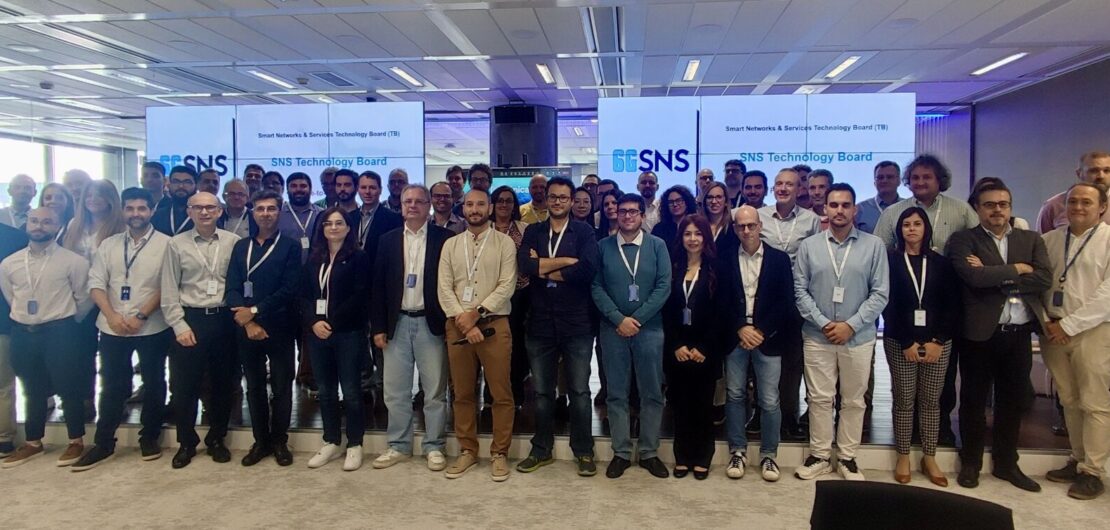
The 6G Smart Networks and Services Industry Association (6G-IA) proudly leads the Technology Board (TB) of the Smart Networks and Services Joint Undertaking (SNS JU) — a dynamic group composed of the Technical Managers from all active SNS JU projects.

Last month, the TB held its 4th Face-to-Face Meeting at Telefónica’s facilities in Madrid, Spain, where representatives from 78 ongoing projects engaged in productive discussions on topics such as R&I-to-standards roadmaps, AI data sharing and reuse, and future TB activities.

During the meeting, members reaffirmed their confidence in Kostas (Konstantinos) Trichias, re-electing him as TB Chairman for a third term. The 6G-IA extends its gratitude to all project representatives for their continued commitment and collaboration, driving forward European innovation and strengthening the impact of Future Networks and Services.

Featured

OpenCAPIF 3.0.0 Is Here — A Major Leap in…

We’re excited to announce the release of OpenCAPIF 3.0.0, now available via ETSI Labs. 
ocf.etsi.org

Building on the 3GPP Common API Framework (Release 18), this third major version delivers robust enhancements across API management, security, and configurability. 
ocf.etsi.org

What’s New in v3.0.0:

➡️Event Filters — Enable finer control of notifications by apiId, aefId, or invokerId within event subscriptions. 


➡️Event Reporting Flexibility — Configure periodic notifications, maximum counts, or subscription expiration. 


➡️Dynamic Configuration — Register and Helper services now support runtime-configurable parameters (e.g. certificate lifetimes, security method precedence) via new endpoints. 


➡️Expanded Security Methods — Full support for PKI and PSK methods, including dynamic key generation for PSK mode. 


➡️Testing & Technical Debt Reduction — New test suites for event filtering and updated logic; service upgrades, hardened startup scripts, and bug fixes complete the release. 


➡️A public sandbox is available for experimentation, and full deployment instructions are included in the release documentation. 

Find out more here: https://ocf.etsi.org/news/release-3/

Featured

Software managed 5G Service Centric For Time-Sensitive Networking Conference…

The SAFE-6G paper entitled “Software managed 5G Service Centric For Time-Sensitive Networking” has been accepted at the 5th International Conference on Electrical, Computer, Communications and Mechatronics Engineering (ICECCME). The conference will feature a comprehensive technical program offering numerous technical sessions with papers showcasing the latest technologies, and applications.
Find out more here: https://www.iceccme.com/ 

Featured

SNS JU Journal 2025

The SNS JU Journal 2025 provides a comprehensive overview of the 79 research, innovation, and trial projects (out of 80) that form the core of the SNS JU’s portfolio. Backed by approximately €500 million in EU funding, these projects are pivotal to Europe’s goal of becoming a global leader in 6G technology, while also advancing the rollout of 5G. This portfolio reflects the strong commitment of European policymakers, industry stakeholders, and researchers to establishing a robust, competitive, and sustainable digital infrastructure. Proud to see SAFE-6G featured among them, advancing secure and sustainable networks. Find it more here: https://smart-networks.europa.eu/sns-journal-2025/#sns-journal-2025-catalogue/148/ 

Featured

An AI-Assisted User-Intent 6G System for Dynamic Throughput Provision

The introduction of 6G technology represents a significant transformation in the telecommunications area, emphasizing a user-centric design to improve personalized communications experiences. This paper proposes an AI-assisted user-intent 6G system that dynamically provisions throughput by adjusting Time Division Duplexing (TDD) slot allocations based on the predicted user intent. An important feature of the system is the AI-powered chatbot which uses Natural Language Processing (NLP) to accurately recognize user needs, translating these into accurate TDD configurations. This paper examines the difficulties of the proposed system, highlighting its potential to enhance the network adaptability and user satisfaction. Through analysis and validation, this paper demonstrates significant improvements in network performance, setting a new standard for intelligent, user-centric telecommunications.

Find the paper online here: https://ieeexplore.ieee.org/document/10942858 

Featured

SAFE-6G at  ARES Conference

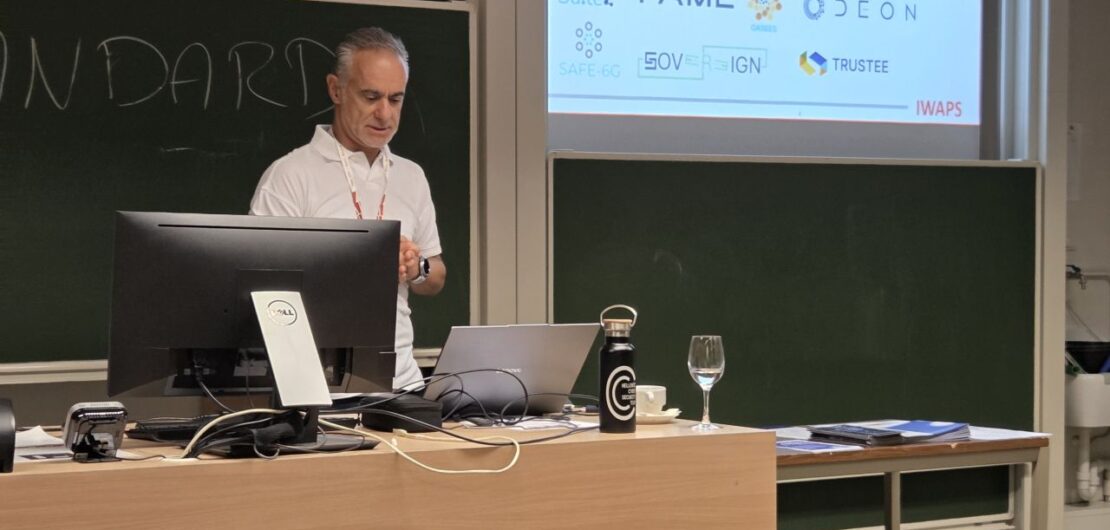
We’re thrilled to share that SAFE-6G—a pioneering Horizon Europe project focused on building trust in 6G networks—was one of the esteemed co-organizers of the 5th International Workshop on Advances on Privacy Preserving Technologies and Solutions (IWAPS), held July 31, 2025, in conjunction with the ARES Conference in Ghent, Belgium

This workshop brought together researchers and practitioners at the forefront of cybersecurity and privacy. It served as a vibrant hub for sharing advances in adaptive privacy, threat detection, trust architectures, and more—especially relevant as we move into the 6G era. SAFE-6G’s involvement underscores our commitment to shaping secure, privacy-preserving AI and next-generation systems 

Being part of a multidisciplinary effort alongside projects like AIAS, aerOS, RESCALE, and others highlights how collaborative innovation is critical for building the trustworthy networks of tomorrow 

A heartfelt thank you to the IWAPS initiative and ARES Conference for fostering such an inspiring forum—and heartfelt appreciation to our team and partners whose contributions made it possible!

Featured

SAFE-6G MLOps framework

The SAFE-6G MLOps framework streamlines the full lifecycle of machine learning (ML) models—from development to deployment—leveraging modern cloud-native technologies. It automates workflows, ensures reproducibility, manages versioning of models and data, and incorporates differential privacy to secure sensitive data. The framework utilizes tools like GitLab CI/CD, Kubeflow, and Kubernetes for continuous integration and deployment, model orchestration, and scalable serving. Key components include a pipeline development environment, orchestration platform using DAGs, and automated model creation with differential privacy. Models are stored and deployed as containerized microservices, ensuring efficient, secure, and dynamic ML operations across edge-cloud environments.
Transcript.

Find it here: https://www.youtube.com/watch?v=-mfUbtJZvwU&ab_channel=SAFE-6Gproject

Featured

SAFE-6G EuCNC & 6G Summit 2025 DEMO video

The main objective of the demo is to showcase the trust capabilities of the SAFE-6G framework MVP, demonstrating how it adapts the trustworthiness of a 5G/6G-based system based on end users’ expressed needs, ensuring that “trust” is not just predefined by operators but is also shaped by real-time user input.

The demo consists of: i) a UE with the LLM-driven chatbot connected to a portable gNB+core locally, used to capture the user-intent, ii) a local laptop running the SAFE-6G Cognitive Coordinator, iii) a remote server forming the continuum, which includes the MLOps module and iv) two trust functions will be demonstrated.

Find it online here: https://www.youtube.com/watch?v=iipGEQCiIkg&t=1s&ab_channel=SAFE-6Gproject